


Learn through the super-clean Baeldung Pro experience:
>> Membership and Baeldung Pro.
No ads, dark-mode and 6 months free of IntelliJ Idea Ultimate to start with.
Learn through the super-clean Baeldung Pro experience:
>> Membership and Baeldung Pro.
No ads, dark-mode and 6 months free of IntelliJ Idea Ultimate to start with.
In recent years, the field of artificial intelligence has witnessed a surge in the development and application of deep learning techniques. While deep learning has revolutionized many areas, such as image recognition and natural language processing, it has faced challenges in effectively handling structured data, particularly graph-structured data. To address these challenges, a groundbreaking technique called Graph Neural Networks (GNNs) has emerged. GNNs enable machines to understand better and process graph-structured data.
In this tutorial, we’ll provide a comprehensive introduction to GNNs, exploring their architecture, training process, and various applications.
Before delving into GNNs, it is crucial to grasp the fundamentals of graphs. A graph is composed of nodes (also known as vertices) connected by edges (also called links or relationships). Nodes represent entities, while edges represent relationships or interactions between these entities. Graphs can be either directed (edges have a specific direction) or undirected (edges are bidirectional). Additionally, graphs may incorporate various attributes or features associated with nodes and edges, providing additional information to enhance learning.
Let’s discover the intricate Jazz Musicians Network dataset, featuring 198 nodes and 2742 edges. The visualization below illustrates distinct communities of Jazz musicians, identified by diverse node colors and connecting edges. This web of connections highlights both intra-community and inter-community collaborations among musicians:
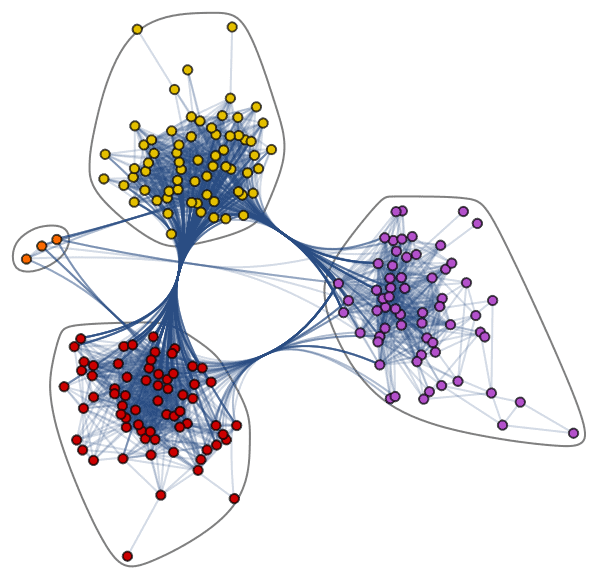
Graphs are particularly adept at tackling intricate challenges involving relationships and interactions. They find applications in diverse domains such as pattern recognition, social network analysis, recommendation systems, and semantic analysis. The development of solutions rooted in graph-based methodologies represents an emerging field that promises profound insights into the complexities of interconnected datasets.
GNNs are a class of deep learning models designed to process and analyze graph-structured data. GNNs leverage the inherent structural information of graphs to learn powerful node and graph representations, enabling them to capture complex dependencies and propagate information effectively across the graph.
GNNs are strongly influenced by graph embedding and Convolutional Neural Networks, and graph embedding have a strong impact on them. GNNs are applied to make predictions concerning nodes, edges, and tasks based on graphs.
The architecture of a GNN consists of multiple layers, each responsible for aggregating and updating information from neighboring nodes. The core idea behind GNNs is the “message-passing” paradigm, where information is exchanged between nodes during the training process. At each layer, the GNN performs two fundamental steps:
By iteratively repeating the message passing and node update steps, the GNN enables information to propagate across the entire graph, allowing nodes to learn and refine their embeddings collectively.
The below table summarizes the differences between GNN, Convolutional Neural Networks (CNNs), and Recurrent Neural Networks (RNNs) based on various aspects:
| Aspect | GNNs | CNNs | RNNs |
|---|---|---|---|
| Input type | Graphs (nodes, edges, features) | Grid-like data (e.g. images) | Sequential data (e.g. time series) |
| Information Flow | Propagates information across nodes | Local receptive fields in convolution | Information passed sequentially |
| Architecture | Message passing, node update | Hierarchical layers of convolutions | Sequential layers of neurons |
| Memory of past data | Incorporates global graph structure | Captures local patterns in the grid | Captures temporal dependencies |
| Applications | Social networks, molecular structures | Image recognition, computer vision | Natural language processing, speech |
| Training complexity | Moderate complexity due to graphs | Complex, numerous layers, large data | Complex due to sequential dependencies |
| Parallel Processing | Limited due to graph structure | High due to parallel convolutions | Limited due to sequential nature |
| Data size tolerance | Sensitive to graph size and structure | Less sensitive, scales with data | Sensitive to sequence length |
In summary, GNNs are designed for graph data, CNNs for grid-like data, and RNNs for sequential data. Each architecture has its strengths and weaknesses, making them better suited for specific tasks and types of input data.
GNNs come in various forms, each tailored to handle specific types of graph-structured data. Some common types of GNNs include:
Training a GNN involves a series of mathematical operations that facilitate the propagation of information through nodes and edges. This section will delve into the mathematical foundations of training GNNs, providing insights into the formulas and processes that drive their learning process.
Before diving into the math, let’s briefly review the architecture of a GNN. As discussed above, a GNN consists of multiple layers comprising two main steps: message passing and node update. These steps are performed iteratively to allow information to flow across the graph. The key lies in the mathematical expressions that govern these steps.
At each layer of a GNN, the message-passing step involves aggregating information from neighboring nodes. Mathematically, for node  at layer
  , the aggregated message
  is calculated as a function of the embeddings of its neighbors
  :
:
![\[m_{v}^{k}=\sum_{u\in N(v)}M^{k}\left(h_{u}^{k-1},h_{v}^{k-1},e_{uv}\right),\]](/wp-content/ql-cache/quicklatex.com-f125fef41e96c682b8fdd49caa4ac1fc_l3.svg "Rendered by QuickLaTeX.com")
where  represents a message aggregation function at layer ,
  and
and  are the embeddings of nodes
  and at the previous layer, and
  represents any edge-specific attributes.
After aggregating messages, the node update step involves using these messages to update the node’s representation. This is done through a function  :
:
![\[h_{v}^{k}=U^{k}\left(h_{v}^{k-1},m_{v}^{k}\right),\]](/wp-content/ql-cache/quicklatex.com-a32d743cb19aaf9e000b7a127cea9c71_l3.svg "Rendered by QuickLaTeX.com")
where is the node update function at layer .
Training a GNN aims to learn the optimal parameters that allow the network to make accurate predictions or classifications based on graph-structured data. This is typically achieved through a supervised learning process using a loss function. The most common approach is to employ backpropagation and gradient descent to optimize the GNN’s parameters.
Below, we outline the capability of GNNs in handling various machine learning tasks:
The versatility of GNNs has led to their successful application in various domains, including:
In this article, we provided a comprehensive introduction to GNNs, exploring the architecture and training process of GNNs, as well as various applications. As research in this field continues to advance, we can expect GNNs to play an increasingly vital role in unlocking the potential of graph-structured data and paving the way for innovative applications in the future.
Graph Neural Networks have emerged as a powerful tool for processing and analyzing graph-structured data. GNNs enable machines to capture complex dependencies and propagate information effectively across nodes by harnessing the rich structural information inherent in graphs.