Different Types of Flows in Mule
Last updated: June 13, 2025


Mocking is an essential part of unit testing, and the Mockito library makes it easy to write clean and intuitive unit tests for your Java code.
Get started with mocking and improve your application tests using our Mockito guide:
Handling concurrency in an application can be a tricky process with many potential pitfalls. A solid grasp of the fundamentals will go a long way to help minimize these issues.
Get started with understanding multi-threaded applications with our Java Concurrency guide:
Spring 5 added support for reactive programming with the Spring WebFlux module, which has been improved upon ever since. Get started with the Reactor project basics and reactive programming in Spring Boot:
Since its introduction in Java 8, the Stream API has become a staple of Java development. The basic operations like iterating, filtering, mapping sequences of elements are deceptively simple to use.
But these can also be overused and fall into some common pitfalls.
To get a better understanding on how Streams work and how to combine them with other language features, check out our guide to Java Streams:
Explore Spring Boot 3 and Spring 6 in-depth through building a full REST API with the framework:
Yes, Spring Security can be complex, from the more advanced functionality within the Core to the deep OAuth support in the framework.
I built the security material as two full courses - Core and OAuth, to get practical with these more complex scenarios. We explore when and how to use each feature and code through it on the backing project.
You can explore the course here:
All Access is finally out, with all of my Spring courses. Learn JUnit is out as well, and Learn Maven is coming fast. And, of course, quite a bit more affordable. Finally.
>> GET THE COURSE
Spring Data JPA is a great way to handle the complexity of JPA with the powerful simplicity of Spring Boot.
Get started with Spring Data JPA through the guided reference course:
Refactor Java code safely — and automatically — with OpenRewrite.
Refactoring big codebases by hand is slow, risky, and easy to put off. That’s where OpenRewrite comes in. The open-source framework for large-scale, automated code transformations helps teams modernize safely and consistently.
Each month, the creators and maintainers of OpenRewrite at Moderne run live, hands-on training sessions — one for newcomers and one for experienced users. You’ll see how recipes work, how to apply them across projects, and how to modernize code with confidence.
Join the next session, bring your questions, and learn how to automate the kind of work that usually eats your sprint time.
1. Introduction
Mule is a Java-based product which provides an enterprise service bus (ESB) solutions. We can develop Mule applications using Anypoint Studio, an Eclipse plugin.
After a brief introduction to ESB’s and flows, we’ll talk about the different types of flows in Mule, and where we use each type.
2. Enterprise Service Bus (ESB)
An ESB is a mediating layer connecting independent pieces of software. These apps often use different protocols. Consequently, the ESB will take care of transforming and routing the data. This allows for the creation of decoupled services. Therefore, each service does not need to worry about how another service will consume its output.
It is the ESB’s job to make sure that the data is in the correct format. We can find more details about Mule ESB in our previous tutorial.
Components are the building blocks of a Mule application. Thus, it’s these components that are responsible for transforming and routing data. We add components to a Mule application from the Mule Palette, on the right-hand side of Anypoint Studio:
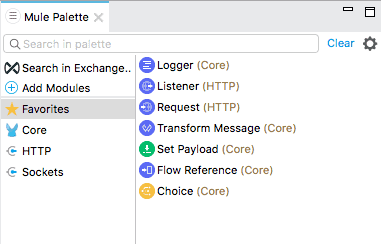
Components are subsequently grouped into flows. A Mule application consists of one or more flows.
3. What Is a Flow?
A flow is a connected collection of Mule components.
It usually consists of an inbound endpoint component (from where a message originates), and an outbound endpoint component. Therefore, the flow is responsible for the various processing stages in which the message may undergo.
Each flow may have a processing strategy as well as an exception handling strategy associated with it. A flow may also reference another flow using a flow reference component.
There are three different types of flows in Mule:
- Subflows – a synchronous flow inheriting the processing and exception handling strategy of the parent flow
- Synchronous Flows – a synchronous flow with its processing and exception handling strategy
- Asynchronous Flows – an asynchronous flow with its processing and exception handling strategy
4. Subflows
We use subflows to group common logic. Subflows are processed synchronously; that is, execution of the calling flow halts until the subflow is complete.
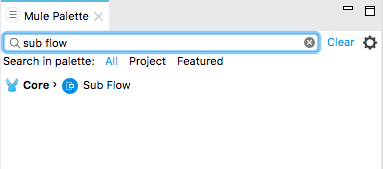
Specifically, we can add a subflow from the Mule Palette:
The subflow is called using a flow reference component:
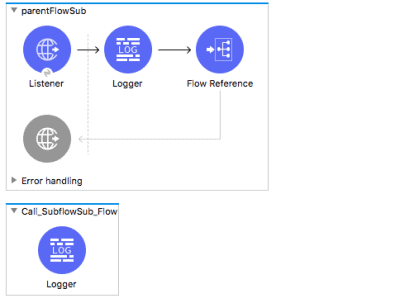
Additionally, subflows inherit the processing strategies and exception handling strategies of the calling flow. We can call a subflow from multiple different flows. Should we not wish to inherit these strategies, we could call a synchronous flow.
5. Synchronous Flows
Like a subflow, a synchronous flow is also processed synchronously. This means that when we call a synchronous flow, it must complete before the parent flow resumes its execution.
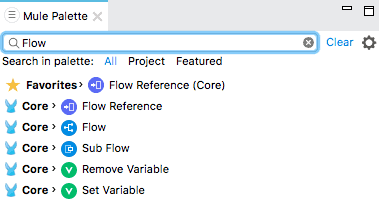
We add synchronous flows to our Mule application by adding regular flows; there is no “synchronous flow” component. We add a regular flow component:
To call the synchronous flow, we again use a flow reference component:
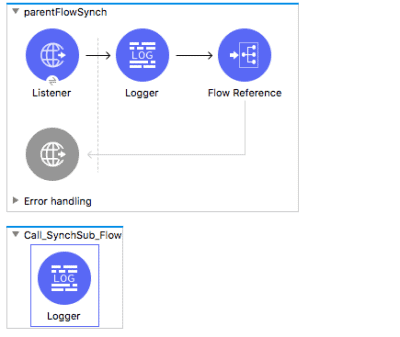
Unlike a subflow, it doesn’t inherit the processing and exception handling strategies of the calling flow. Consequently, the processing and exception handling strategies of the calling flow do not affect the behavior of this type of flow.
For these reasons, this type of flow is ideal for transactional processing since messages processed using synchronous flows execute on a single thread.
6. Asynchronous Flows
Asynchronous flows execute in parallel to the calling flow; i.e., they are processed asynchronously.
We add asynchronous flows to the Mule application in the same way we add synchronous ones. So, what makes the flow asynchronous, is that we call it from within an asynchronous scope. We can do this by wrapping the flow reference component in an async component:
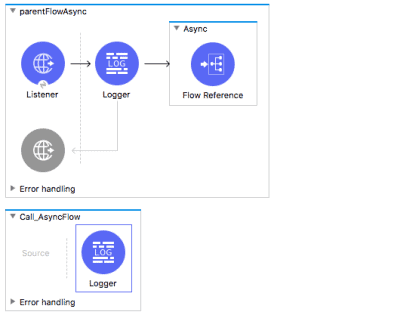
Similarly to synchronous flows – they don’t inherit the processing and exception handling strategies of the calling flow.
Additionally, messages processed using asynchronous flows execute on multiple threads, making this type of flow ideal for time-consuming tasks such as sending out emails or performing I/O operations.
7. Conclusion
In this short tutorial, we discussed the characteristics of the different types of flows in Mule.
For more information visit the official Mule website.














