Mocking is an essential part of unit testing, and the Mockito library makes it easy to write clean and intuitive unit tests for your Java code.
Get started with mocking and improve your application tests using our Mockito guide:
Handling concurrency in an application can be a tricky process with many potential pitfalls. A solid grasp of the fundamentals will go a long way to help minimize these issues.
Get started with understanding multi-threaded applications with our Java Concurrency guide:
Spring 5 added support for reactive programming with the Spring WebFlux module, which has been improved upon ever since. Get started with the Reactor project basics and reactive programming in Spring Boot:
Since its introduction in Java 8, the Stream API has become a staple of Java development. The basic operations like iterating, filtering, mapping sequences of elements are deceptively simple to use.
But these can also be overused and fall into some common pitfalls.
To get a better understanding on how Streams work and how to combine them with other language features, check out our guide to Java Streams:
Explore Spring Boot 3 and Spring 6 in-depth through building a full REST API with the framework:
Yes, Spring Security can be complex, from the more advanced functionality within the Core to the deep OAuth support in the framework.
I built the security material as two full courses - Core and OAuth, to get practical with these more complex scenarios. We explore when and how to use each feature and code through it on the backing project.
You can explore the course here:
All Access is finally out, with all of my Spring courses. Learn JUnit is out as well, and Learn Maven is coming fast. And, of course, quite a bit more affordable. Finally.
>> GET THE COURSE
Spring Data JPA is a great way to handle the complexity of JPA with the powerful simplicity of Spring Boot.
Get started with Spring Data JPA through the guided reference course:
Refactor Java code safely — and automatically — with OpenRewrite.
Refactoring big codebases by hand is slow, risky, and easy to put off. That’s where OpenRewrite comes in. The open-source framework for large-scale, automated code transformations helps teams modernize safely and consistently.
Each month, the creators and maintainers of OpenRewrite at Moderne run live, hands-on training sessions — one for newcomers and one for experienced users. You’ll see how recipes work, how to apply them across projects, and how to modernize code with confidence.
Join the next session, bring your questions, and learn how to automate the kind of work that usually eats your sprint time.
Get up to speed with the core of Maven quickly, and then go beyond the foundations into the more powerful functionality of the build tool, such as profiles, scopes, multi-module projects and quite a bit more:
1. Introduction
Sometimes when a jar in our local Maven repo is corrupt, we’ll see the error: Invalid LOC Header.
In this tutorial, we’re going to learn when it happens and how to handle and even at times prevent it.
2. When Does “Invalid LOC Header” Occur?
Maven downloads a project’s dependencies into a known location on our filesystem called a local repository. Every artifact that Maven downloads is also accompanied by its SHA1 and MD5 checksum files:
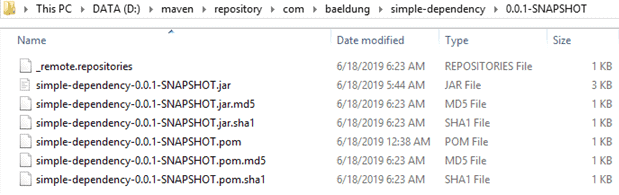
The purpose of these checksums is to ensure the integrity of the associated artifacts. Since networks and file systems can fail, just like anything else, there are times when artifacts get corrupted, making the artifact contents not match the signature.
In these situations, Maven builds throw an “invalid LOC header” error.
The solution is to remove the corrupt jar from the repository. Let’s see a couple of ways.
3. Delete the Local Repository
A quick-fix for the error is to delete the whole Maven local repository and build the project again:
rm -rf ${LOCAL_REPOSITORY}This will erase the local cache and re-download all the project dependencies – not very efficient.
Note that the default local repository is at ${user.home}/.m2/repository unless we specified it in our settings.xml <localRepository> tag. We can also find the local repository by the command: mvn help:evaluate -Dexpression=settings.localRepository
4. Find the Corrupt Jar
Another solution is to identify the specific corrupt jar and delete it from the local repository.
When we use the Maven output stack trace command, it’ll contain the corrupt jar details when it fails to process it.
We can enable debug level logging by adding -X to the build command:
mvn -X packageThe resulting stack trace will indicate the corrupted jar towards the end of the log. After identifying the corrupted jar, we can locate it in the local repository and delete it. Now upon build, Maven will retry downloading the jar.
Also, we can test the integrity of the archive with the zip -T command:
find ${LOCAL_REPOSITORY} -name "*.jar" | xargs -L 1 zip -T | grep error5. Validate Checksums
The two solutions mentioned earlier will only force Maven to re-download the jar. Of course, the issue could occur again in future downloads. We can prevent that by configuring Maven to validate the checksum while downloading the artifact from a remote repository.
We can add the –strict-checksums or -C option to the Maven command. This will cause Maven to fail the build if the computed checksum doesn’t match the value in checksum files.
There are two options, either to fail the build if checksums don’t match:
-C,--strict-checksumsor warn which is the default option:
-c,--lax-checksumsToday Maven requires the signature files while uploading artifacts to the central repository. But there might be artifacts in the central repository that don’t have the signature files, particularly the historic ones. That is why the default option is warn.
For a more permanent solution, we can configure checksumPolicy in Maven’s settings.xml file. This property specifies the behavior when verification of an artifact checksum fails. To avoid problems in the future, let’s edit our settings.xml file to fail the download when the checksum fails:
<profiles>
    <profile>
        <repositories>
            <repository>
                <id>codehausSnapshots</id>
                <name>Codehaus Snapshots</name>
                <releases>
                    <enabled>false</enabled>
                    <updatePolicy>always</updatePolicy>
                    <checksumPolicy>fail</checksumPolicy>
                </releases>
            </repository>
        </repository>
    </profile>
</profiles>
We’d, of course, need to do this for each of our configured repositories.
6. Conclusion
In this quick write-up, we’ve seen when an invalid LOC header error can occur and options for how to handle it.