Checking Which Java Version Is Running in Eclipse
Last updated: July 20, 2024


Mocking is an essential part of unit testing, and the Mockito library makes it easy to write clean and intuitive unit tests for your Java code.
Get started with mocking and improve your application tests using our Mockito guide:
Handling concurrency in an application can be a tricky process with many potential pitfalls. A solid grasp of the fundamentals will go a long way to help minimize these issues.
Get started with understanding multi-threaded applications with our Java Concurrency guide:
Spring 5 added support for reactive programming with the Spring WebFlux module, which has been improved upon ever since. Get started with the Reactor project basics and reactive programming in Spring Boot:
Since its introduction in Java 8, the Stream API has become a staple of Java development. The basic operations like iterating, filtering, mapping sequences of elements are deceptively simple to use.
But these can also be overused and fall into some common pitfalls.
To get a better understanding on how Streams work and how to combine them with other language features, check out our guide to Java Streams:
Explore Spring Boot 3 and Spring 6 in-depth through building a full REST API with the framework:
Yes, Spring Security can be complex, from the more advanced functionality within the Core to the deep OAuth support in the framework.
I built the security material as two full courses - Core and OAuth, to get practical with these more complex scenarios. We explore when and how to use each feature and code through it on the backing project.
You can explore the course here:
All Access is finally out, with all of my Spring courses. Learn JUnit is out as well, and Learn Maven is coming fast. And, of course, quite a bit more affordable. Finally.
>> GET THE COURSE
Spring Data JPA is a great way to handle the complexity of JPA with the powerful simplicity of Spring Boot.
Get started with Spring Data JPA through the guided reference course:
Refactor Java code safely — and automatically — with OpenRewrite.
Refactoring big codebases by hand is slow, risky, and easy to put off. That’s where OpenRewrite comes in. The open-source framework for large-scale, automated code transformations helps teams modernize safely and consistently.
Each month, the creators and maintainers of OpenRewrite at Moderne run live, hands-on training sessions — one for newcomers and one for experienced users. You’ll see how recipes work, how to apply them across projects, and how to modernize code with confidence.
Join the next session, bring your questions, and learn how to automate the kind of work that usually eats your sprint time.
1. Overview
When working with Java in the Eclipse IDE, ensuring the correct Java version is essential for compiling and executing code accurately. Eclipse simplifies this process by providing straightforward methods to check and configure the Java version it uses. In this tutorial, we’ll walk through the steps to determine the Java version running in Eclipse.
2. Java in Eclipse: Environment vs. Project Configuration
It’s important to differentiate between the Java version used within Eclipse itself, which may differ from the Java version configured for specific projects within Eclipse.
While Eclipse’s own Java version impacts its operations and functionalities, individual projects within Eclipse can be configured to use different JDKs or JREs based on project requirements. This allows us to tailor the Java environment for each project, ensuring compatibility and optimal performance. Therefore, while it’s crucial to determine the Java version running in Eclipse, we should also be mindful of project-specific Java configurations to avoid compatibility issues and ensure smooth development workflows.
3. Checking Which Java Version Is Running in Eclipse
In this section, we’ll explore how to determine the Java version currently running in the Eclipse IDE.
3.1. Using the Eclipse IDE Installation Details
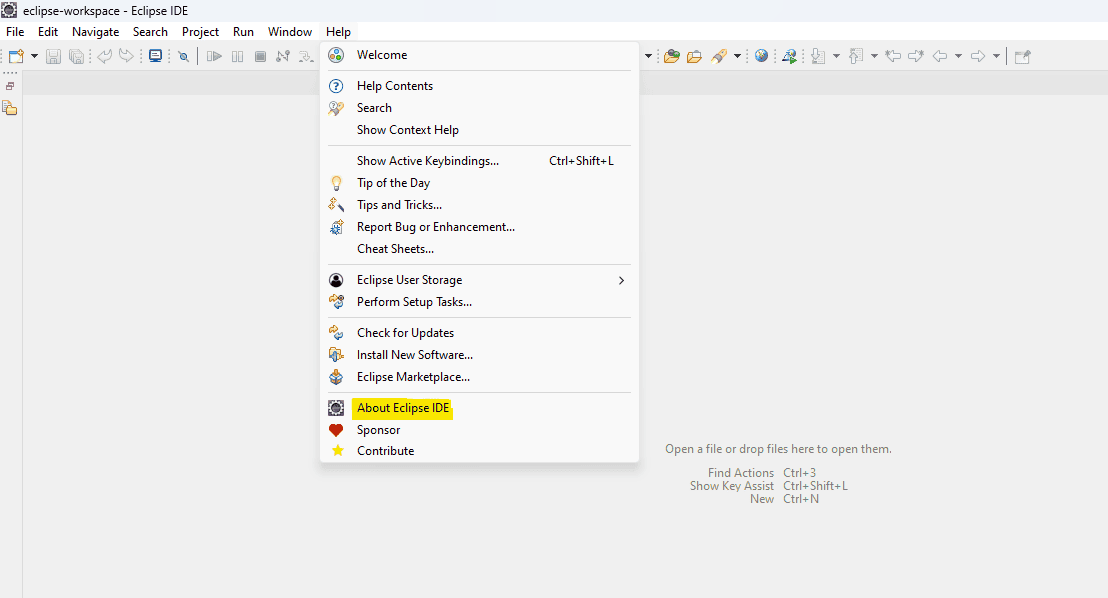
To start, let’s open the Eclipse IDE and then navigate to “Help” in the menu bar. Then, we can select “About Eclipse IDE“:
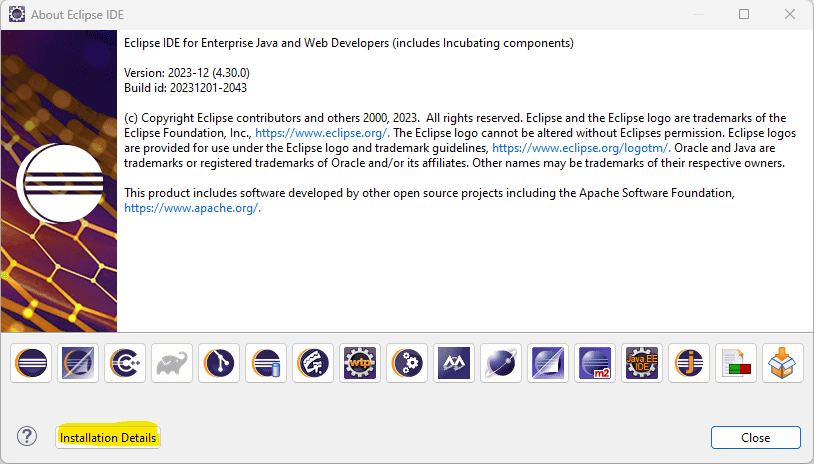
Within the “About Eclipse IDE” dialog box, let’s click on the “Installation Details” button:
In the ensuing popup, we switch to the “Configuration” tab:
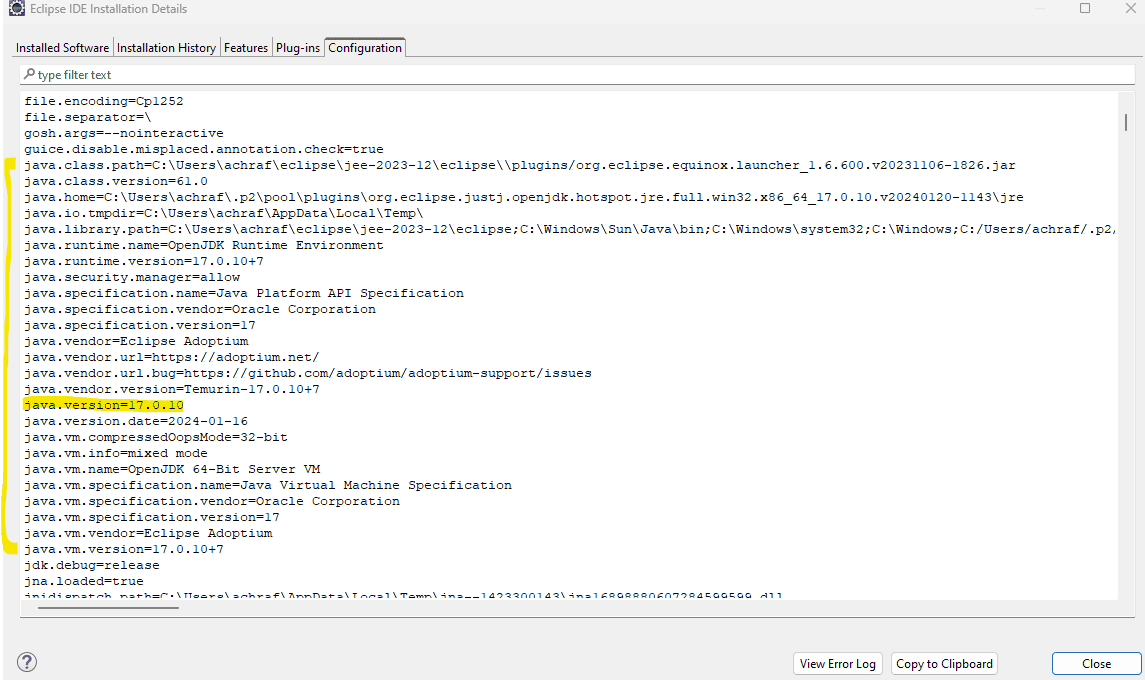
Under the Configuration tab, we can locate essential Java properties that provide valuable information about the Eclipse IDE Java configuration. These properties include:
- java.version: specifies the Java Development Kit (JDK) version being utilized
- java.runtime.version: indicates the version of the Java Runtime Environment (JRE) currently in use
- java.vm.version: specifies the version of the Java Virtual Machine (JVM)
In the above example, the Eclipse IDE is running under Java version 17.0.10.
3.2. Checking the eclipse.ini File
Another way to determine the Java version used in Eclipse is to inspect the eclipse.ini file. Typically located within the Eclipse installation directory, this file contains configuration settings for Eclipse IDE, including the Java configuration.
Let’s open this file in a text editor and locate the line that starts with -vm, which specifies the location of the Java executable that Eclipse should use:
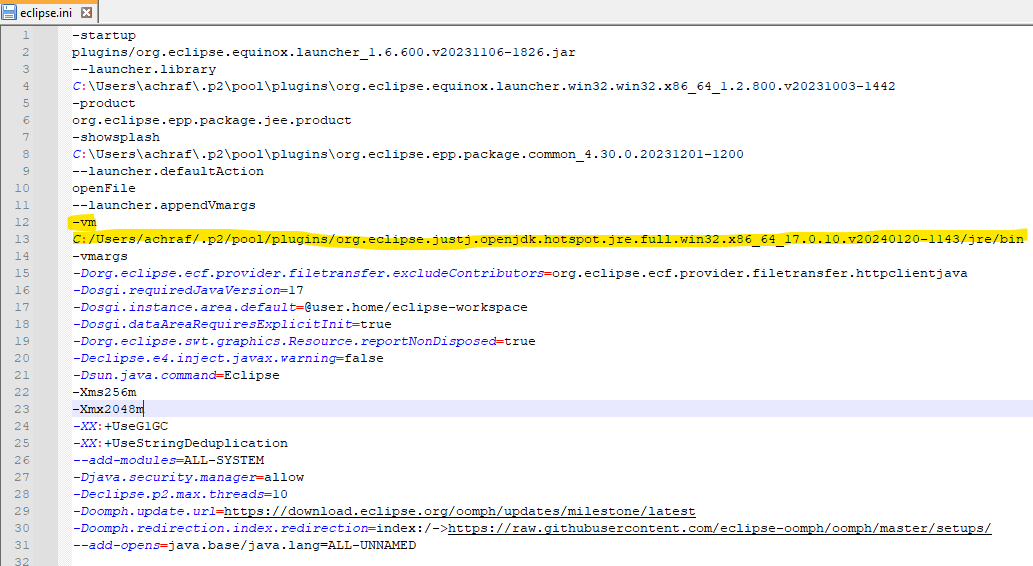
While the -vm option in the eclipse.ini file specifies the path to the Java executable, it doesn’t directly reveal the exact Java version used in Eclipse IDE. For instance, the path specified in our eclipse.ini file provides insights suggesting Eclipse’s usage of Java 17. However, a path like C:\Program\Java\jdk\bin offers no indication regarding the Java version in use.
To determine the exact Java version, we need to navigate to the path defined in the -vm option of the eclipse.ini file and execute java –version in a command prompt.
The -vm option provides flexibility as we can modify the associated path to point to a different JDK installation directory. Also, removing these lines allows Eclipse to use the Java version specified in the PATH system environment variable.
3. Conclusion
Identifying the Java version running in Eclipse is essential for us to ensure compatibility and leverage the latest language features.
By following the methods in this article, we can easily determine the Java version configured within Eclipse. This understanding empowers us to make informed decisions while developing Java applications within the Eclipse IDE.














