


Mocking is an essential part of unit testing, and the Mockito library makes it easy to write clean and intuitive unit tests for your Java code.
Get started with mocking and improve your application tests using our Mockito guide:
Handling concurrency in an application can be a tricky process with many potential pitfalls. A solid grasp of the fundamentals will go a long way to help minimize these issues.
Get started with understanding multi-threaded applications with our Java Concurrency guide:
Spring 5 added support for reactive programming with the Spring WebFlux module, which has been improved upon ever since. Get started with the Reactor project basics and reactive programming in Spring Boot:
Since its introduction in Java 8, the Stream API has become a staple of Java development. The basic operations like iterating, filtering, mapping sequences of elements are deceptively simple to use.
But these can also be overused and fall into some common pitfalls.
To get a better understanding on how Streams work and how to combine them with other language features, check out our guide to Java Streams:
Explore Spring Boot 3 and Spring 6 in-depth through building a full REST API with the framework:
Yes, Spring Security can be complex, from the more advanced functionality within the Core to the deep OAuth support in the framework.
I built the security material as two full courses - Core and OAuth, to get practical with these more complex scenarios. We explore when and how to use each feature and code through it on the backing project.
You can explore the course here:
Spring Data JPA is a great way to handle the complexity of JPA with the powerful simplicity of Spring Boot.
Get started with Spring Data JPA through the guided reference course:
Refactor Java code safely — and automatically — with OpenRewrite.
Refactoring big codebases by hand is slow, risky, and easy to put off. That’s where OpenRewrite comes in. The open-source framework for large-scale, automated code transformations helps teams modernize safely and consistently.
Each month, the creators and maintainers of OpenRewrite at Moderne run live, hands-on training sessions — one for newcomers and one for experienced users. You’ll see how recipes work, how to apply them across projects, and how to modernize code with confidence.
Join the next session, bring your questions, and learn how to automate the kind of work that usually eats your sprint time.
1. Overview
In this tutorial, we’ll briefly explain why testing private methods directly is generally not a good idea. Then we’ll demonstrate how to test private methods in Java if it’s necessary.
2. Why We Shouldn’t Test Private Methods
As a rule, the unit tests we write should only check our public methods contracts. Private methods are implementation details that the callers of our public methods aren’t aware of. Furthermore, changing our implementation details shouldn’t lead us to change our tests.
Generally speaking, urging to test a private method highlights one of the following problems:
- We have dead code in our private method.
- Our private method is too complex and should belong to another class.
- Our method wasn’t meant to be private in the first place.
Hence, when we feel like we need to test a private method, what we should really do is fix the underlying design problem instead.
3. An Example: Remove Dead Code From a Private Method
Let’s showcase a quick example of that.
We’re going to write a private method that will return the double of an Integer. For null values, we want to return null:
private static Integer doubleInteger(Integer input) {
    if (input == null) {
        return null;
    }
    return 2 * input;
}
Now, let’s write our public method. It’ll be the only entry point from outside the class.
This method receives an Integer as an input. It validates that this Integer isn’t null; otherwise, it throws an IllegalArgumentException. After that, it calls the private method to return twice the Integer‘s value:
public static Integer validateAndDouble(Integer input) {
    if (input == null) {
        throw new IllegalArgumentException("input should not be null");
    }
    return doubleInteger(input);
}
Let’s follow our good practice and test our public method contract.
First, let’s write a test that ensures that an IllegalArgumentException is thrown if the input is null:
@Test
void givenNull_WhenValidateAndDouble_ThenThrows() {
    assertThrows(IllegalArgumentException.class, () -> validateAndDouble(null));
}
Now let’s check that a non-null Integer is correctly doubled:
@Test
void givenANonNullInteger_WhenValidateAndDouble_ThenDoublesIt() {
    assertEquals(4, validateAndDouble(2));
}
Let’s have a look at the coverage reported by the JaCoCo plugin:
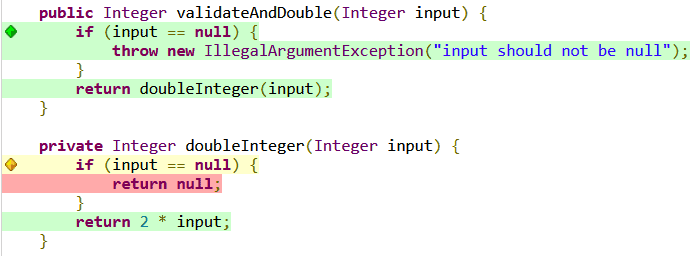 As we can see, the null check inside our private method isn’t covered by our unit tests. Should we test it then?
The answer is no. It’s important to understand that our private method doesn’t exist in a vacuum. It’ll only be called after the data is validated in our public method. Thus, the null check in our private method will never be reached; it’s dead code and should be removed.
4. How to Test Private Methods in Java
Assuming we’re not discouraged, let’s explain how to test our private method concretely.
To test it, it would be helpful if our private method had another visibility. The good news is that we’ll be able to simulate that with reflection.
Our encapsulating class is called Utils. The idea is to access the private method called doubleInteger, which accepts an Integer as a parameter. Then we’ll modify its visibility to be accessible from outside the Utils class. Let’s see how we can do that:
private Method getDoubleIntegerMethod() throws NoSuchMethodException {
    Method method = Utils.class.getDeclaredMethod("doubleInteger", Integer.class);
    method.setAccessible(true);
    return method;
}
Now we’re able to use this method. Let’s write a test to ensure that, given a null object, our private method returns null. We’ll need to apply the method to a parameter that will be null:
@Test
void givenNull_WhenDoubleInteger_ThenNull() throws InvocationTargetException, IllegalAccessException, NoSuchMethodException {
    assertEquals(null, getDoubleIntegerMethod().invoke(null, new Integer[] { null }));
}
Let’s explain a bit more about the usage of the invoke method. The first argument is the object on which we apply the method. As doubleInteger is static, we passed in a null. The second argument is an array of parameters. In this case, we had only one parameter, and it was null.
Finally, let’s demonstrate how we can also test the case of a non-null input:
@Test
void givenANonNullInteger_WhenDoubleInteger_ThenDoubleIt() throws NoSuchMethodException, InvocationTargetException, IllegalAccessException {
    assertEquals(74, getDoubleIntegerMethod().invoke(null, 37));
}
5. Conclusion
In this article, we learned why testing private methods is generally not a good idea. Then we demonstrated how to use reflection to test a private method in Java.














