


Mocking is an essential part of unit testing, and the Mockito library makes it easy to write clean and intuitive unit tests for your Java code.
Get started with mocking and improve your application tests using our Mockito guide:
Handling concurrency in an application can be a tricky process with many potential pitfalls. A solid grasp of the fundamentals will go a long way to help minimize these issues.
Get started with understanding multi-threaded applications with our Java Concurrency guide:
Spring 5 added support for reactive programming with the Spring WebFlux module, which has been improved upon ever since. Get started with the Reactor project basics and reactive programming in Spring Boot:
Since its introduction in Java 8, the Stream API has become a staple of Java development. The basic operations like iterating, filtering, mapping sequences of elements are deceptively simple to use.
But these can also be overused and fall into some common pitfalls.
To get a better understanding on how Streams work and how to combine them with other language features, check out our guide to Java Streams:
Explore Spring Boot 3 and Spring 6 in-depth through building a full REST API with the framework:
Yes, Spring Security can be complex, from the more advanced functionality within the Core to the deep OAuth support in the framework.
I built the security material as two full courses - Core and OAuth, to get practical with these more complex scenarios. We explore when and how to use each feature and code through it on the backing project.
You can explore the course here:
All Access is finally out, with all of my Spring courses. Learn JUnit is out as well, and Learn Maven is coming fast. And, of course, quite a bit more affordable. Finally.
>> GET THE COURSE
Spring Data JPA is a great way to handle the complexity of JPA with the powerful simplicity of Spring Boot.
Get started with Spring Data JPA through the guided reference course:
Refactor Java code safely — and automatically — with OpenRewrite.
Refactoring big codebases by hand is slow, risky, and easy to put off. That’s where OpenRewrite comes in. The open-source framework for large-scale, automated code transformations helps teams modernize safely and consistently.
Each month, the creators and maintainers of OpenRewrite at Moderne run live, hands-on training sessions — one for newcomers and one for experienced users. You’ll see how recipes work, how to apply them across projects, and how to modernize code with confidence.
Join the next session, bring your questions, and learn how to automate the kind of work that usually eats your sprint time.
1. Introduction
In this tutorial, we’ll show various ways in which we can generate prime numbers using Java.
If you’re looking to check if a number is prime – here’s a quick guide on how to do that.
2. Prime Numbers
Let’s start with the core definition. A prime number is a natural number greater than one that has no positive divisors other than one and itself.
For example, 7 is prime because 1 and 7 are its only positive integer factors, whereas 12 is not because it has the divisors 3 and 2 in addition to 1, 4 and 6.
3. Generating Prime Numbers
In this section, we’ll see how we can generate prime numbers efficiently that are lower than a given value.
3.1. Java 7 and Before – Brute Force
public static List<Integer> primeNumbersBruteForce(int n) {
    List<Integer> primeNumbers = new LinkedList<>();
    for (int i = 2; i <= n; i++) {
        if (isPrimeBruteForce(i)) {
            primeNumbers.add(i);
        }
    }
    return primeNumbers;
}
public static boolean isPrimeBruteForce(int number) {
    for (int i = 2; i < number; i++) {
        if (number % i == 0) {
            return false;
        }
    }
    return true;
}
As you can see, primeNumbersBruteForce is iterating over the numbers from 2 to n and simply calling the isPrimeBruteForce() method to check if a number is prime or not.
The method checks each numbers divisibility by the numbers in a range from 2 till number-1.
If at any point we encounter a number that is divisible, we return false. At the end when we find that number is not divisible by any of its prior number, we return true indicating its a prime number.
3.2. Efficiency and Optimization
The previous algorithm is not linear and has the time complexity of O(n^2). The algorithm is also not efficient and there’s clearly a room for improvement.
Let’s look at the condition in the isPrimeBruteForce() method.
When a number is not a prime, this number can be factored into two factors namely a and b i.e. number = a * b. If both a and b were greater than the square root of n, a*b would be greater than n.
So at least one of those factors must be less than or equal the square root of a number and to check if a number is prime, we only need to test for factors lower than or equal to the square root of the number being checked.
Additionally, prime numbers can never be an even number as even numbers are all divisible by 2.
Keeping in mind above ideas, let’s improve the algorithm:
public static List<Integer> primeNumbersBruteForce(int n) {
    List<Integer> primeNumbers = new LinkedList<>();
    if (n >= 2) {
        primeNumbers.add(2);
    }
    for (int i = 3; i <= n; i += 2) {
        if (isPrimeBruteForce(i)) {
            primeNumbers.add(i);
        }
    }
    return primeNumbers;
}
private static boolean isPrimeBruteForce(int number) {
    for (int i = 2; i*i <= number; i++) {
        if (number % i == 0) {
            return false;
        }
    }
    return true;
}
3.3. Using Java 8
Let’s see how we can rewrite the previous solution using Java 8 idioms:
public static List<Integer> primeNumbersTill(int n) {
    return IntStream.rangeClosed(2, n)
      .filter(x -> isPrime(x)).boxed()
      .collect(Collectors.toList());
}
private static boolean isPrime(int number) {
    return IntStream.rangeClosed(2, (int) (Math.sqrt(number)))
      .allMatch(n -> x % n != 0);
}
3.4. Using Sieve of Eratosthenes
There’s yet another efficient method which could help us to generate prime numbers efficiently, and it’s called Sieve Of Eratosthenes. Its time efficiency is O(n logn).
Let’s take a look at the steps of this algorithm:
- Create a list of consecutive integers from 2 to n: (2, 3, 4, …, n)
- Initially, let p be equal 2, the first prime number
- Starting from p, count up in increments of p and mark each of these numbers greater than p itself in the list. These numbers will be 2p, 3p, 4p, etc.; note that some of them may have already been marked
- Find the first number greater than p in the list that is not marked. If there was no such number, stop. Otherwise, let p now equal this number (which is the next prime), and repeat from step 3
At the end when the algorithm terminates, all the numbers in the list that are not marked are the prime numbers.
Here’s what the code looks like:
public static List<Integer> sieveOfEratosthenes(int n) {
    boolean prime[] = new boolean[n + 1];
    Arrays.fill(prime, true);
    for (int p = 2; p * p <= n; p++) {
        if (prime[p]) {
            for (int i = p * 2; i <= n; i += p) {
                prime[i] = false;
            }
        }
    }
    List<Integer> primeNumbers = new LinkedList<>();
    for (int i = 2; i <= n; i++) {
        if (prime[i]) {
            primeNumbers.add(i);
        }
    }
    return primeNumbers;
}
3.5. Working Example of Sieve of Eratosthenes
Let’s see how it works for n=30.
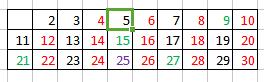
Consider the image above, here are the passes made by the algorithm:
- The loop starts with 2, so we leave 2 unmarked and mark all the divisors of 2. It’s marked in image with the red color
- The loop moves to 3, so we leave 3 unmarked and mark all the divisors of 3 not already marked. It’s marked in image with the green color
- Loop moves to 4, it’s already marked, so we continue
- Loop moves to 5, so we leave 5 unmarked and mark all the divisors of 5 not already marked. It’s marked in image with the purple color
- We continue above steps until loop is reached equal to square root of n
4. Conclusion
In this quick tutorial, we illustrated ways in which we can generate prime numbers until ‘N’ value.














