


Mocking is an essential part of unit testing, and the Mockito library makes it easy to write clean and intuitive unit tests for your Java code.
Get started with mocking and improve your application tests using our Mockito guide:
Handling concurrency in an application can be a tricky process with many potential pitfalls. A solid grasp of the fundamentals will go a long way to help minimize these issues.
Get started with understanding multi-threaded applications with our Java Concurrency guide:
Spring 5 added support for reactive programming with the Spring WebFlux module, which has been improved upon ever since. Get started with the Reactor project basics and reactive programming in Spring Boot:
Since its introduction in Java 8, the Stream API has become a staple of Java development. The basic operations like iterating, filtering, mapping sequences of elements are deceptively simple to use.
But these can also be overused and fall into some common pitfalls.
To get a better understanding on how Streams work and how to combine them with other language features, check out our guide to Java Streams:
Explore Spring Boot 3 and Spring 6 in-depth through building a full REST API with the framework:
Yes, Spring Security can be complex, from the more advanced functionality within the Core to the deep OAuth support in the framework.
I built the security material as two full courses - Core and OAuth, to get practical with these more complex scenarios. We explore when and how to use each feature and code through it on the backing project.
You can explore the course here:
All Access is finally out, with all of my Spring courses. Learn JUnit is out as well, and Learn Maven is coming fast. And, of course, quite a bit more affordable. Finally.
>> GET THE COURSE
Spring Data JPA is a great way to handle the complexity of JPA with the powerful simplicity of Spring Boot.
Get started with Spring Data JPA through the guided reference course:
Refactor Java code safely — and automatically — with OpenRewrite.
Refactoring big codebases by hand is slow, risky, and easy to put off. That’s where OpenRewrite comes in. The open-source framework for large-scale, automated code transformations helps teams modernize safely and consistently.
Each month, the creators and maintainers of OpenRewrite at Moderne run live, hands-on training sessions — one for newcomers and one for experienced users. You’ll see how recipes work, how to apply them across projects, and how to modernize code with confidence.
Join the next session, bring your questions, and learn how to automate the kind of work that usually eats your sprint time.
1. Introduction
Cucumber hooks can come in handy when we want to perform specific actions for every scenario or step, but without having these actions explicitly in the Gherkin code.
In this tutorial, we’ll look at the @Before, @BeforeStep, @AfterStep, and @After Cucumber hooks.
2. Overview of Hooks in Cucumber
2.1. When Should Hooks Be Used?
Hooks can be used to perform background tasks that are not part of business functionality. Such tasks could be:
- Starting up a browser
- Setting or clearing cookies
- Connecting to a database
- Checking the state of the system
- Monitoring
A use case for monitoring would be to update a dashboard with the test progress in real-time.
Hooks are not visible in the Gherkin code. Therefore, we should not see them as a replacement for a Cucumber Background or a given step.
We’ll look at an example where we use hooks to take screenshots during test execution.
2.2. Scope of Hooks
Hooks affect every scenario. Therefore, it’s good practice to define all hooks in a dedicated configuration class.
It’s not necessary to define the same hooks in every glue code class. If we define hooks in the same class with our glue code, we’d have less readable code.
3. Hooks
Let’s first look at the individual hooks. We’ll then look at a full example where we’ll see how hooks execute when combined.
3.1. @Before
Methods annotated with @Before will execute before every scenario. In our example, we’ll start up the browser before every scenario:
@Before
public void initialization() {
    startBrowser();
}
If we annotate several methods with @Before, we can explicitly define the order in which the steps are executed:
@Before(order=2)
public void beforeScenario() {
    takeScreenshot();
}
The above method executes second, as we pass 2 as a value for the order parameter to the annotation. We can also pass 1 as a value for the order parameter of our initialization method:
@Before(order=1)
public void initialization()
So, when we execute a scenario, initialization() executes first, and beforeScenario() executes second.
3.2. @BeforeStep
Methods annotated with @BeforeStep execute before every step. Let’s use the annotation to take a screenshot before every step:
@BeforeStep
public void beforeStep() {
    takeScreenshot();
}
3.3. @AfterStep
Methods annotated with @AfterStep execute after every step:
@AfterStep
public void afterStep() {
    takeScreenshot();
}
We’ve used @AfterStep here to take a screenshot after every step. This happens regardless of whether the step finishes successfully or fails.
3.4. @After
Methods annotated with @After execute after every scenario:
@After
public void afterScenario() {
    takeScreenshot();
    closeBrowser();
}
In our example, we’ll take a final screenshot and close the browser. This happens regardless of whether the scenario finishes successfully.
3.5. The Scenario Parameter
The methods annotated with a hook annotation can accept a parameter of type Scenario:
@After
public void beforeScenario(Scenario scenario) {
    // some code
}
The object of type Scenario contains information on the current scenario. Included are the scenario name, number of steps, names of steps, and status (pass or fail). This can be useful if we want to perform different actions for passed and failed tests.
4. Hook Execution
4.1. Happy Flow
Let’s now look at what happens when we run a Cucumber scenario with all four types of hooks:
Feature: Book Store With Hooks
  Background: The Book Store
    Given The following books are available in the store
      | The Devil in the White City          | Erik Larson |
      | The Lion, the Witch and the Wardrobe | C.S. Lewis  |
      | In the Garden of Beasts              | Erik Larson |

  Scenario: 1 - Find books by author
    When I ask for a book by the author Erik Larson
    Then The salesperson says that there are 2 books

  Scenario: 2 - Find books by author, but isn't there
    When I ask for a book by the author Marcel Proust
    Then The salesperson says that there are 0 books
Looking at the result of a test run in the IntelliJ IDE, we can see the execution order:
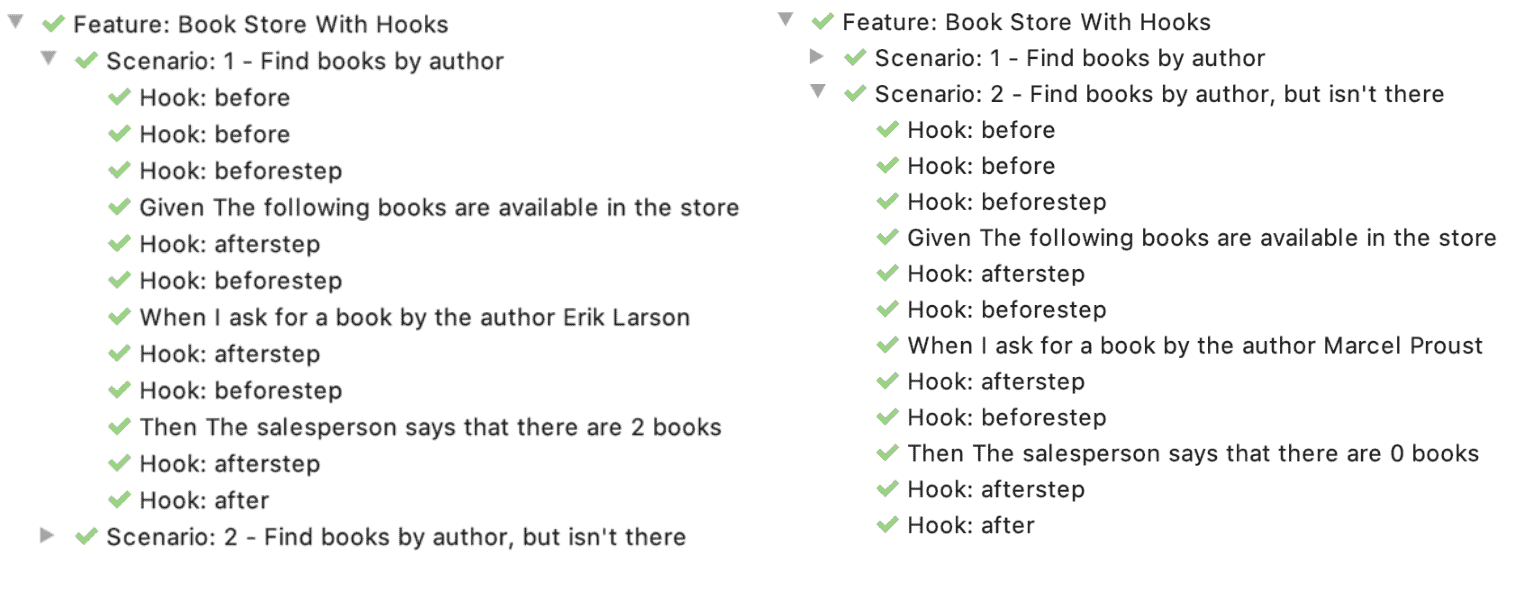
First, our two @Before hooks execute. Then before and after every step, the @BeforeStep and @AfterStep hooks run, respectively. Finally, the @After hook runs. All hooks execute for both scenarios.
4.2. Unhappy Flow: a Step Fails
Let’s see what happens if a step fails. As we can see in the screenshot below, both the @Before and @After hooks of the failing step are executed. The subsequent steps are skipped, and finally, the @After hook executes:
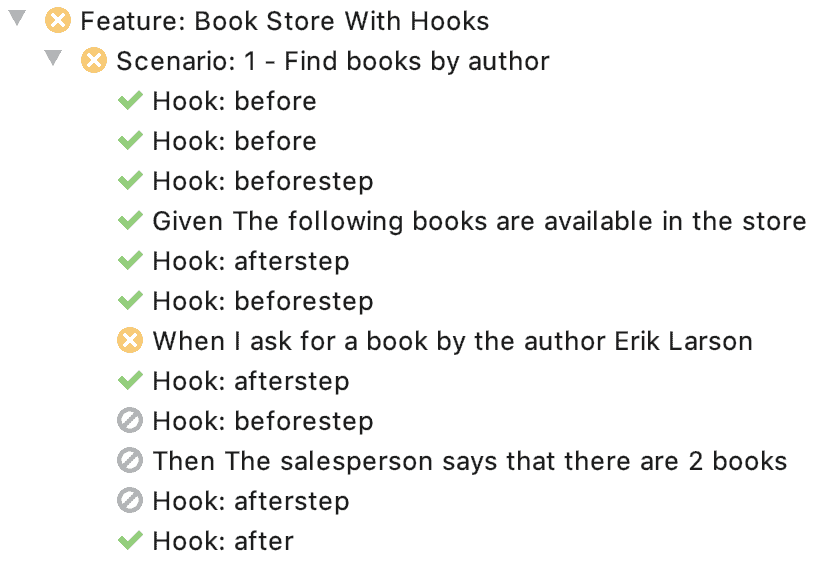
The behavior of @After is similar to the finally-clause after a try-catch in Java. We could use it to perform clean-up tasks if a step failed. In our example, we still take a screenshot even if the scenario fails.
4.3. Unhappy Flow: a Hook Fails
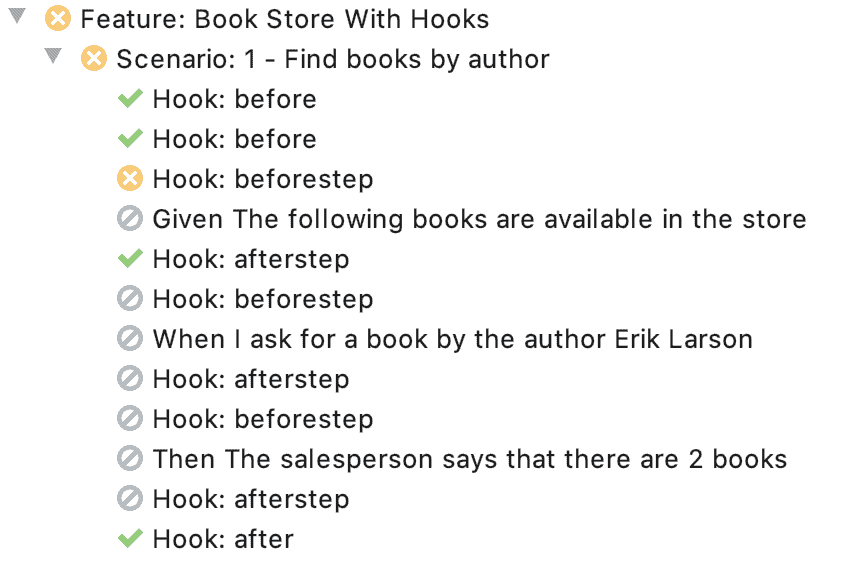
Let’s look at what happens when a hook itself fails. In the example below, the first @BeforeStep fails.
In this case, the actual step doesn’t run, but it’s @AfterStep hook does. Subsequent steps won’t run either, whereas the @After hook is executed at the end:
5. Conditional Execution with Tags
Hooks are defined globally and affect all scenarios and steps. However, with the help of Cucumber tags, we can define exactly which scenarios a hook should be executed for:
@Before(order=2, value="@Screenshots")
public void beforeScenario() {
    takeScreenshot();
}
This hook will be executed only for scenarios that are tagged with @Screenshots:
@Screenshots
Scenario: 1 - Find books by author
When I ask for a book by the author Erik Larson
Then The salesperson says that there are 2 books
6. Java 8
We can add Cucumber Java 8 Support to define all hooks with lambda expressions.
Recall our initialization hook from the example above:
@Before(order=2)
public void initialization() {
    startBrowser();
}
Rewritten with a lambda expression, we get:
public BookStoreWithHooksRunSteps() {
    Before(2, () -> startBrowser());
}
The same also works for @BeforeStep, @After, and @AfterStep.
7. Conclusion
In this article, we looked at how to define Cucumber hooks.
We discussed in which cases we should use them and when we should not. Then, we saw in which order hooks execute and how we can achieve conditional execution.
Finally, we saw how we could define hooks with Java 8 lambda notation.














