


Learn through the super-clean Baeldung Pro experience:
>> Membership and Baeldung Pro.
No ads, dark-mode and 6 months free of IntelliJ Idea Ultimate to start with.
Learn through the super-clean Baeldung Pro experience:
>> Membership and Baeldung Pro.
No ads, dark-mode and 6 months free of IntelliJ Idea Ultimate to start with.
PKCS7 is a member of the Public-Key Cryptography Standards (PKCS) family created by the RSA Laboratories. The PKCS7 file format is a robust cryptographic standard for storing signed and encrypted data.
Secure message transmission over the Internet requires PKCS7, which includes encryption and digital certificates. Furthermore, the PKCS7 standard guarantees the confidentiality and immutability of digital communication.
In this tutorial, we’ll discuss the role of PKCS7 in data security and software applications.
In the early 1990s, RSA Security LLC developed PKCS standards to encourage the use of cryptographic methods such as the RSA algorithm. Over time, the PKIX working group and the IETF have adopted several of these standards.
PKCS standards guarantee safe communications and data sharing across various platforms. They provide numerous solutions for issues related to digital security. For example, RSA encryption and decryption are in PKCS1, which is essential for secure communications.
PKCS7, known as Cryptographic Message Syntax (CMS), is a universal message format for data sharing, signing, and encrypting communications.
PKCS guidelines are essential for building a secure environment for validating digital identities and carrying out safe transactions. They also extend support for data encryption, digital signatures, certificates, and cryptographic token interfaces.
The CMS Standard (an IETF standard) defines the structure of a PKCS7 file. It has been encapsulated in multiple RFCs over time, the most recent of which is RFC 5652. A PKCS#7-based file is illustrated below:
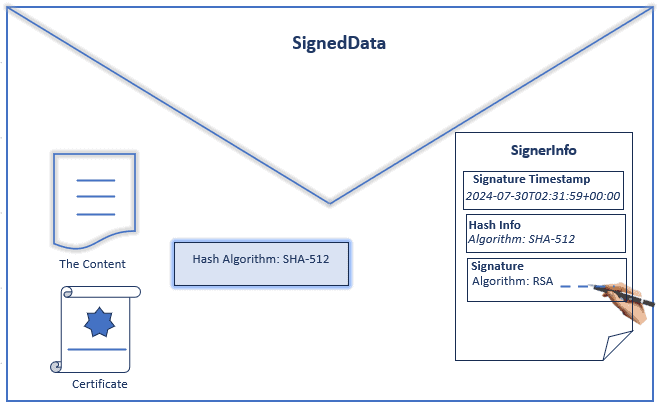
A PKCS7 file with a digital signature will have a ‘SignedData’ block with the following elements:
To provide a reliable and safe digital environment, PKCS7-formatted files primarily contain information such as X.509 public key certificates and CRLs. Further, PKCS7 files hold encrypted data and certificates.
PKCS7 guarantees the confidentiality of private information during data exchange. Authenticated and validated data using a private key in PKCS7 are known as signed data.
The data are encrypted for an additional layer of security, and PKCS7 requires the use of a hashing algorithm.
PKCS7 is a powerful tool for secure digital communications, as it can protect emails using S/MIME, among other data formats.
Using digital signatures and certificates controlled by a PKI, PKCS7 offers a safe way to exchange data:
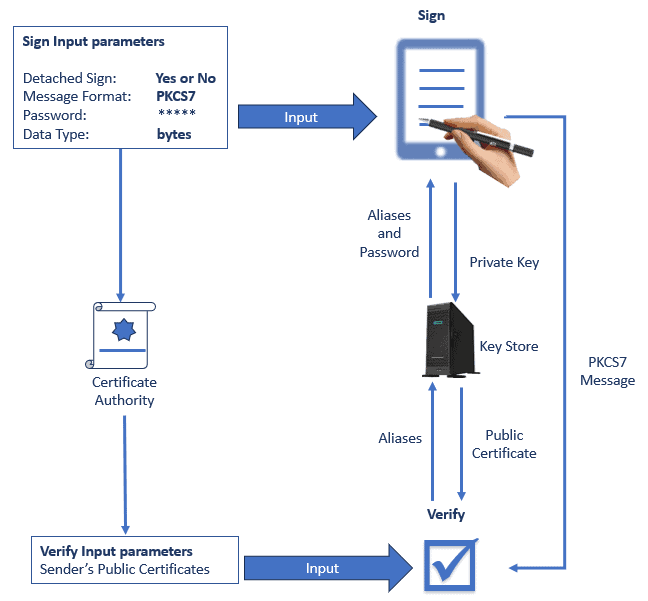
The process begins with the creation of a key pair, ensuring secure signing with a private key and reliable verification with a public key. Employing a robust hashing algorithm, a unique cryptographic hash of the document is generated and signed.
This hash, once encrypted with the signer’s private key, forms the digital signature, which is then appended to the document alongside the signer’s certificate.
The following figure shows the encryption and decryption process with PKCS7:

The sender’s private key facilitates encrypting the signature. We verify the public key’s validity in the key store using the sender’s public certificate.
We use the certificate alias to identify it in the key store. The decryption process uses the recipient’s private key alias and key password to access and decrypt the message using the private key from the key store.
Let’s compare PKCS7 to other formats:
| Feature |
PKCS#7 | X.509 | DER | PEMs |
| Encoding | Base64 ASCII | Binary | Binary | Base64 ASCII |
| File Extensions | .p7b, .p7c | .cer, .crt | .der | .pem, .crt |
| Contains Private Keys | No | No | No | Yes |
| Usage | Certificates and CRLs | Certificates | Certificates | Certificates and Private Keys |
| Bundling | Can bundle multiple certificates | Single certificate | Single certificate | Can bundle multiple certificates |
Although PKCS7 can hold a chain of certificates, private keys are not included in it and are maintained mostly in the PEM format. This is to preserve their privacy.
Let’s now discuss the advantages and limitations of PKCS7:
| Advantages |
Limitations |
| Versatility: PKCS#7 can be used to sign or encrypt data using X.509 certificates | Complexity: Managing and understanding the structure can be complex due to its versatility |
| Multiple Certificates: It allows for the storage of multiple certificates in a single container, which is useful for certificate chains. | Compatibility: Some systems may not support PKCS#7, leading to compatibility issues. |
| Data Integrity: Ensures the integrity of the transmitted data through digital signatures. | Performance: Encryption and decryption processes can be resource-intensive. |
| Confidentiality: Provides encryption capabilities to maintain the confidentiality of the data. | Key Management: Requires careful management of public and private keys, which can be challenging. |
| Non-repudiation: Offers non-repudiation by verifying the identity of the sender through digital signatures. | Size Overhead: Encrypted data can be significantly larger than the original data, leading to increased storage and transmission requirements. |
PKCS7 benefits include widespread support across various platforms, as well as the ability to sign and encrypt data using X.509 certificates. However, PKCS7 has limitations, especially when it comes to newer encryption algorithms and larger blocks.
PKCS7 is still regarded as a fundamental element of digital security due to its balance between accessibility and robust cryptography.
In this article, we discussed the importance of the PKCS7 file format.
For developers and organizations seeking to safeguard their online communications and data, PKCS7 is an essential standard for software application security.