
1. Overview
Every developer eventually faces the same set of structural problems: how to create objects in a flexible, decoupled way, how to organize classes that grow in complexity, and how to manage communication between components that keep multiplying. Design patterns offer proven answers to these recurring challenges.
In this lesson, we’ll explore what design patterns are, why they exist, and how they help us write better software. We’ll look at the real cost of solving common problems from scratch every time, discover how patterns create a shared vocabulary that transforms team communication, and walk through the three major categories that organize the most widely-known patterns.
There’s no code we need to check out to follow along with this lesson.
2. What Are Design Patterns?
In software, “design” refers to the structural decisions we make about how code is organized: which classes exist, how they relate to each other, and how responsibilities are distributed among them. These decisions connect the syntax of a language and the high-level architecture of a system. Design patterns operate at exactly this level.
2.1. Defining Patterns
Experienced developers rarely start from a blank slate when they face a familiar problem. Over the years, the software community has identified recurring solutions to common design problems, and these solutions have been documented, refined, and given names. That’s essentially what a design pattern is, a reusable template for solving a particular category of problem in software design:

It helps to be clear about what patterns are not:
- A pattern isn’t a library we can import or a framework we can plug into a project.
- It isn’t a finished piece of code we copy and paste.
- It isn’t a rule to follow blindly. Patterns should only be applied when they are useful or necessary.
Instead, a pattern describes a general approach, a blueprint for structuring classes and objects in a way that has been shown to work well across many different contexts. The actual implementation in any language is an adaptation of the pattern, varying depending on the project and its specific requirements.
3. The Problem Patterns Solve: Reinventing the Wheel
3.1. The Cost of Ad-Hoc Solutions
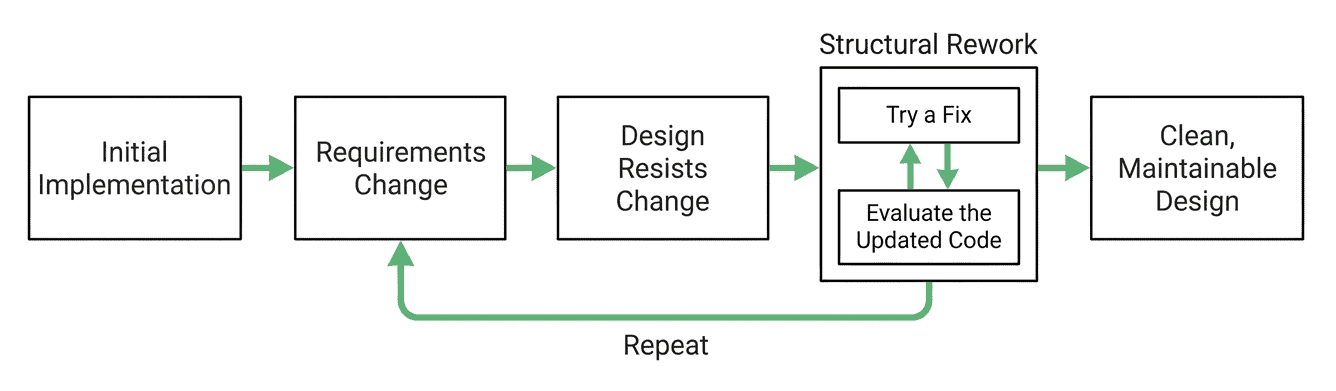
When a developer encounters a design problem for the first time, the natural response is to build something that addresses the immediate issue. The result is typically a structurally immature solution: one that solves today’s problem but lacks the flexibility to accommodate change. When requirements evolve, that initial design starts to resist modification, and the developer ends up in a costly cycle of trial and error, reworking the structure until it finally reaches something clean, flexible, and maintainable. This iteration cost is the primary price of ad-hoc solutions:
Beyond the structural cost, ad-hoc solutions also create secondary problems at the team level. When each developer invents their own approach to the same category of problem, the codebase fills with inconsistent designs. New team members struggle to learn the project because there’s no predictable structure. Code reviews take longer because reviewers need to evaluate each custom solution on its own merits rather than recognizing a familiar approach.
3.2. How Patterns Help
Patterns address this directly. They’re solution blueprints that have been tested across thousands of projects and refined over decades. When a team adopts patterns, they get a thought-through starting point rather than a blank page. Every pattern has already been evaluated, its trade-offs are well understood, and its failure modes are documented.
What’s particularly interesting is that many developers are already using patterns without realizing it. Widely adopted frameworks such as Spring use patterns internally. For example, factory patterns manage object creation, the Singleton pattern controls instance lifecycles, and the Template Method pattern defines algorithmic skeletons throughout the framework. Learning patterns gives us names and structure to techniques that are already part of the ecosystem.
In addition to faster development, patterns result in readable, maintainable, and extendable code. One of the main reasons is that patterns communicate intent. When a developer encounters a familiar pattern in a codebase, they immediately understand both what the code does and why it’s structured that way.
The contrast between ad-hoc and pattern-based approaches is most visible over time. An ad-hoc solution starts as a quick fix and accumulates complexity with every requirement change, while a pattern-based solution begins with a tested foundation that absorbs change with minimal modification:
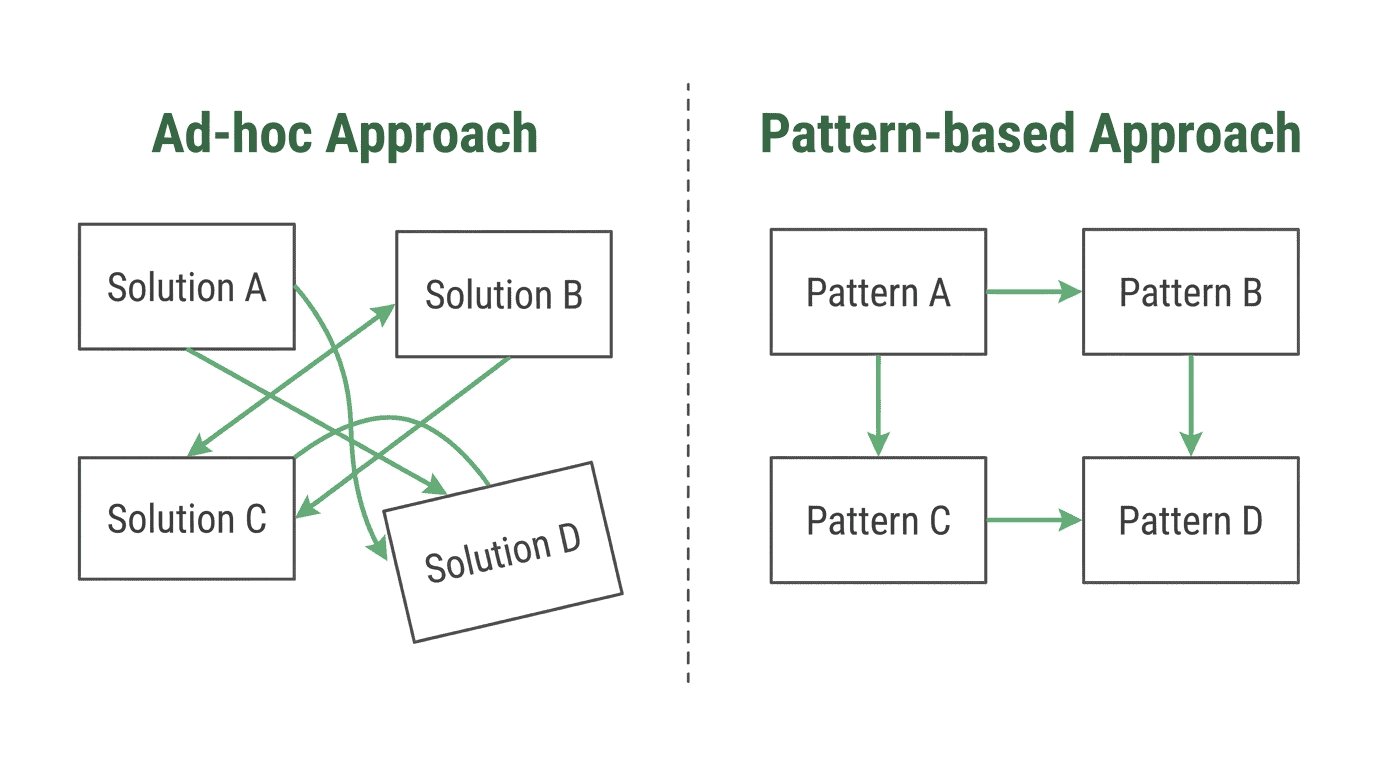
Patterns don’t just shape how we write code — they shape how we handle change.
4. Shared Vocabulary: Communicating with Patterns
Beyond the structural benefits, patterns improve communication. Consider the difference between these two statements in a code review:
“We should create an interface that defines a family of algorithms, encapsulate each one in its own class, and make them interchangeable so the client can switch between them at runtime.”
Compare that with:
“Let’s use the Strategy pattern here.”
They have the same meaning, but the second version takes a fraction of the time to say and leaves no room for ambiguity. Therefore, pattern names act as a compressed language for design concepts. A single term conveys the full set of expectations about class structure, object roles, and interaction behavior.
The vocabulary benefit extends beyond a single team. Pattern names are widely recognized across the industry:
- Technical interviews often explore pattern knowledge.
- Open-source projects reference patterns in their documentation and contributor guides.
- Blog posts and conference talks use pattern names as shorthand.
Knowing this vocabulary is a professional asset that pays off in conversations at every level, from pair programming to system design discussions.
Now that we understand the two core benefits of patterns (preventing reinvention and enabling communication), we need a way to organize and classify them. That framework already exists, and it comes from the most influential book in the history of software design patterns.
5. The Gang of Four and Pattern Categories
In 1994, four authors published a book that changed how the software industry thinks about object-oriented design. Erich Gamma, Richard Helm, Ralph Johnson, and John Vlissides, collectively known as the “Gang of Four,” wrote Design Patterns: Elements of Reusable Object-Oriented Software.
The book catalogued 23 patterns, falling into three categories based on what aspect of software design each pattern addresses.
These three categories map to three fundamental concerns in any object-oriented system:
- How objects are created
- How they’re composed into larger structures
- How they communicate with each other
Let’s look at each one.
5.1. Creational Patterns
Creational patterns deal with object-creation mechanisms. The core idea is to abstract the instantiation process so that the system doesn’t depend on exactly how its objects are created, composed, or represented.
Imagine a service that needs a database connection. Without a creational pattern, every component that needs a connection creates its own: choosing the implementation, configuring parameters, and managing initialization. When the database changes, that logic must be updated in every affected component.
The Factory Method pattern solves this by centralizing connection creation: each component calls a factory method and receives a ready-to-use connection, with no knowledge of how it was created. Switching the underlying database requires changing only the factory.
This separation of creation from use is the principle behind all creational patterns. In a growing application, the way we create objects tends to become tangled with business logic. Creational patterns separate these two concerns. As a result, changing how an object is created doesn’t affect the rest of the code. This course covers several creational patterns, including Singleton, Factory Method, Abstract Factory, and Builder.
5.2. Structural Patterns
Structural patterns address how classes and objects are combined to form larger structures. These patterns help us design relationships between entities so that when one part of the system changes, the rest can stay the same.
Take integrating a third-party logging library whose interface doesn’t match what our application expects. The Adapter pattern gives us a principled way to bridge this incompatibility without changing either side. Without it, we’d either modify the library (usually not possible), rewrite parts of our application to match it, or create tangled workarounds.
These patterns are particularly valuable when integrating existing components or adapting interfaces that weren’t originally designed to work together. We’ll explore Adapter, Decorator, Facade, and Proxy in detail throughout this course.
5.3. Behavioral Patterns
Behavioral patterns focus on how objects communicate and distribute responsibility. They define the protocols for interaction between objects and help us manage complex flows of control.
Think of a notification system where multiple components — an email sender, an SMS handler, and a push notification service — must react whenever a new user registers. Without a behavioral pattern, the registration class must reference and call all three components directly, and adding a fourth notification channel means modifying the registration class itself. The Observer pattern removes this tight coupling: the registration class simply notifies its subscribers, with no knowledge of who they are or how many there are.
This example shows that when a system grows, the web of interactions between objects can grow too complex to manage efficiently. Behavioral patterns provide tested approaches for organizing these interactions. The course covers Strategy, Observer, Template Method, and Command.
5.4. Categorization Criteria
Each pattern category addresses a different design challenge. Recognizing which category a problem falls into is the first step toward identifying the right pattern. A problem about object creation points toward creational patterns, a problem about composing objects points toward structural patterns, and a problem about managing interactions points toward behavioral patterns:
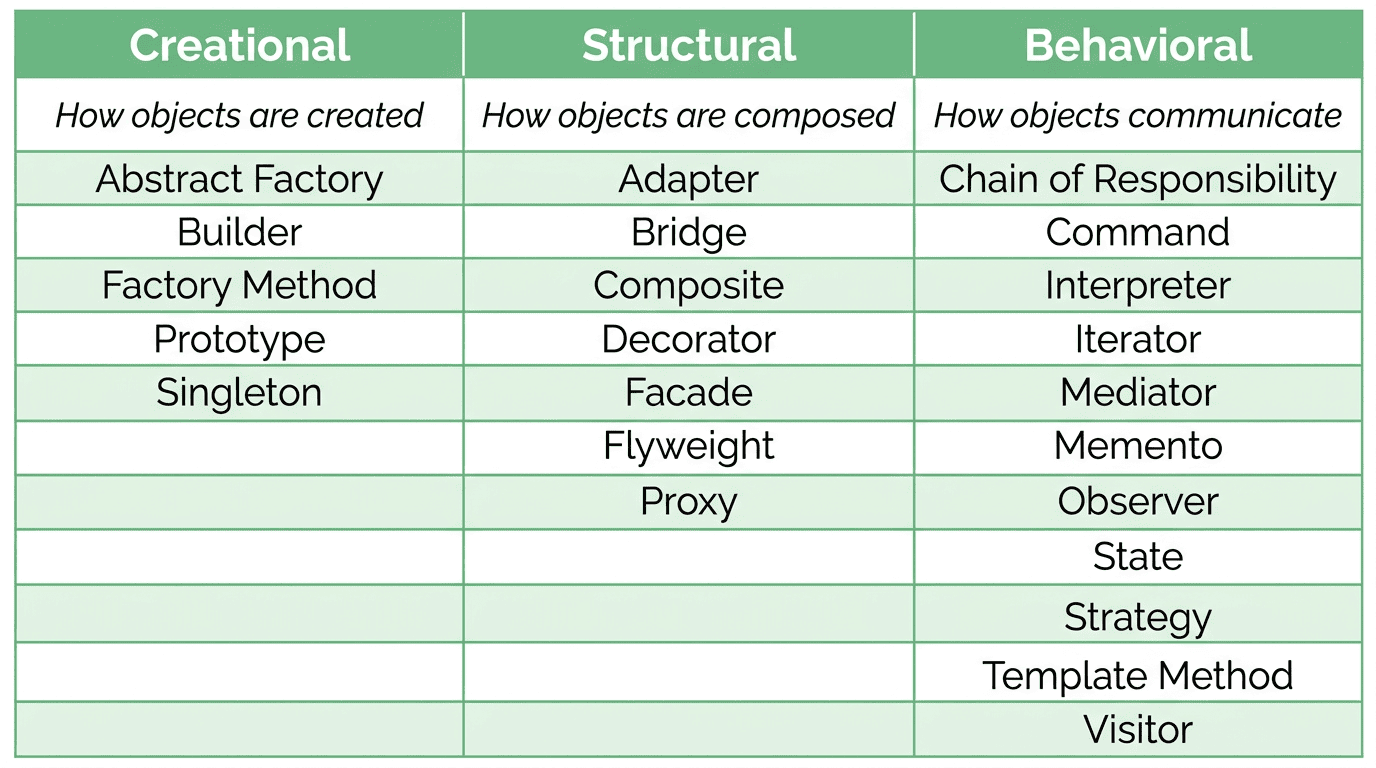
While each category has a primary focus, issues involving structure, behavior, and creation are often related. A behavioral pattern may influence how objects are composed or instantiated, but its primary intent is to define communication and responsibility. Classification follows the primary effects, focus, and intent, not side effects.
6. Conclusion
Design patterns are proven solutions to the recurring problems that every developer is likely to encounter. Patterns prevent us from reinventing the wheel by providing tested blueprints, and they give teams a shared vocabulary that makes communication more efficient.
The Gang of Four organized the most widely-known patterns into three categories. Creational patterns handle object creation, structural patterns manage composition, and behavioral patterns govern communication between objects. These three categories define a roadmap for the rest of this course.