Efficient Word Frequency Calculator in Java
Last updated: December 19, 2017


Mocking is an essential part of unit testing, and the Mockito library makes it easy to write clean and intuitive unit tests for your Java code.
Get started with mocking and improve your application tests using our Mockito guide:
Handling concurrency in an application can be a tricky process with many potential pitfalls. A solid grasp of the fundamentals will go a long way to help minimize these issues.
Get started with understanding multi-threaded applications with our Java Concurrency guide:
Spring 5 added support for reactive programming with the Spring WebFlux module, which has been improved upon ever since. Get started with the Reactor project basics and reactive programming in Spring Boot:
Since its introduction in Java 8, the Stream API has become a staple of Java development. The basic operations like iterating, filtering, mapping sequences of elements are deceptively simple to use.
But these can also be overused and fall into some common pitfalls.
To get a better understanding on how Streams work and how to combine them with other language features, check out our guide to Java Streams:
Explore Spring Boot 3 and Spring 6 in-depth through building a full REST API with the framework:
Yes, Spring Security can be complex, from the more advanced functionality within the Core to the deep OAuth support in the framework.
I built the security material as two full courses - Core and OAuth, to get practical with these more complex scenarios. We explore when and how to use each feature and code through it on the backing project.
You can explore the course here:
Spring Data JPA is a great way to handle the complexity of JPA with the powerful simplicity of Spring Boot.
Get started with Spring Data JPA through the guided reference course:
Refactor Java code safely — and automatically — with OpenRewrite.
Refactoring big codebases by hand is slow, risky, and easy to put off. That’s where OpenRewrite comes in. The open-source framework for large-scale, automated code transformations helps teams modernize safely and consistently.
Each month, the creators and maintainers of OpenRewrite at Moderne run live, hands-on training sessions — one for newcomers and one for experienced users. You’ll see how recipes work, how to apply them across projects, and how to modernize code with confidence.
Join the next session, bring your questions, and learn how to automate the kind of work that usually eats your sprint time.
Regression testing is an important step in the release process, to ensure that new code doesn't break the existing functionality. As the codebase evolves, we want to run these tests frequently to help catch any issues early on.
The best way to ensure these tests run frequently on an automated basis is, of course, to include them in the CI/CD pipeline. This way, the regression tests will execute automatically whenever we commit code to the repository.
In this tutorial, we'll see how to create regression tests using Selenium, and then include them in our pipeline using GitHub Actions:, to be run on the LambdaTest cloud grid:
1. Overview
In this tutorial, we’ll show various ways of implementing a word counter in Java.
2. Counter Implementations
Let’s start by simply calculating the word count of words in this array:
static String[] COUNTRY_NAMES
  = { "China", "Australia", "India", "USA", "USSR", "UK", "China",
  "France", "Poland", "Austria", "India", "USA", "Egypt", "China" };
If we want to process huge files, we need to go for other options described here.
2.1. Map With Integers
One of the simplest solutions would be to create a Map, store words as keys and the number of occurrences as values:
Map<String, Integer> counterMap = new HashMap<>();

for (String country : COUNTRY_NAMES) {
    counterMap.compute(country, (k, v) -> v == null ? 1 : v + 1);
}

assertEquals(3, counterMap.get("China").intValue());
assertEquals(2, counterMap.get("India").intValue());
We simply used Map‘s handy compute method, which increments the counter or initializes it with 1 if the key isn’t present.
However, this method of creating a counter isn’t efficient as Integer is immutable, so every time we increment the counter, we create a new Integer object.
2.2. Stream API
Now, let’s leverage Java 8 Stream API, parallel Streams, and the groupingBy() collector:
@Test
public void whenMapWithLambdaAndWrapperCounter_runsSuccessfully() {
    Map<String, Long> counterMap = new HashMap<>();

    Stream.of(COUNTRY_NAMES)
      .collect(Collectors.groupingBy(k -> k, ()-> counterMap,
	    Collectors.counting());

    assertEquals(3, counterMap.get("China").intValue());
    assertEquals(2, counterMap.get("India").intValue());
}
Similarly, we could use a parallelStream:
@Test
public void whenMapWithLambdaAndWrapperCounter_runsSuccessfully() {
    Map<String, Long> counterMap = new HashMap<>();

    Stream.of(COUNTRY_NAMES).parallel()
      .collect(Collectors.groupingBy(k -> k, ()-> counterMap,
	    Collectors.counting());

    assertEquals(3, counterMap.get("China").intValue());
    assertEquals(2, counterMap.get("India").intValue());
}
2.3. Map With an Integer Array
Next, let’s use a Map that wraps a counter within an Integer array used as a value:
@Test
public void whenMapWithPrimitiveArrayCounter_runsSuccessfully() {
    Map<String, int[]> counterMap = new HashMap<>();

    counterWithPrimitiveArray(counterMap);

    assertEquals(3, counterMap.get("China")[0]);
    assertEquals(2, counterMap.get("India")[0]);
}

private void counterWithPrimitiveArray(Map<String, int[]> counterMap) {
    for (String country : COUNTRY_NAMES) {
        counterMap.compute(country, (k, v) -> v == null ?
          new int[] { 0 } : v)[0]++;
    }
}
Note how we created a simple HashMap with int arrays as values.
In the counterWithPrimitiveArray method, while iterating over each value of the array, we:
- invoke a get on the counterMap by passing the country name as a key
- check whether a key was already present or not. If the entry is already present, we create a new instance of a primitive integer array with a single “1”. If the entry is absent, we increment the counter value present in the array
This method is better than the wrapper implementation – as it creates fewer objects.
2.4. Map With a MutableInteger
Next, let’s create a wrapper object which embeds a primitive integer counter as below:
private static class MutableInteger {
    int count = 1;

    public void increment() {
        this.count++;
    }

    // getter and setter
}
Let’s see how we can make use of the above class as a counter:
@Test
public void whenMapWithMutableIntegerCounter_runsSuccessfully() {
    Map<String, MutableInteger> counterMap = new HashMap<>();

    mapWithMutableInteger(counterMap);

    assertEquals(3, counterMap.get("China").getCount());
    assertEquals(2, counterMap.get("India").getCount());
}
private void counterWithMutableInteger(
  Map<String, MutableInteger> counterMap) {
    for (String country : COUNTRY_NAMES) {
        counterMap.compute(country, (k, v) -> v == null
          ? new MutableInteger(0) : v).increment();
    }
}
In the mapWithMutableInteger method, while iterating over each country in the COUNTRY_NAMES array, we:
- invoke a get on the counterMap by passing the country name as a key
- check whether the key is already present or not. If an entry is absent, we create an instance of MutableInteger, which sets the counter value to 1. We increment the counter value present in the MutableInteger if the country is present in the map
This method of creating a counter is better than the previous one – as we’re reusing the same MutableInteger and thereby creating fewer objects.
This is how Apache Collections HashMultiSet works where it embeds a HashMap with value as MutableInteger internally.
3. Performance Analysis
Here’s the chart that compares the performance of every method listed above.
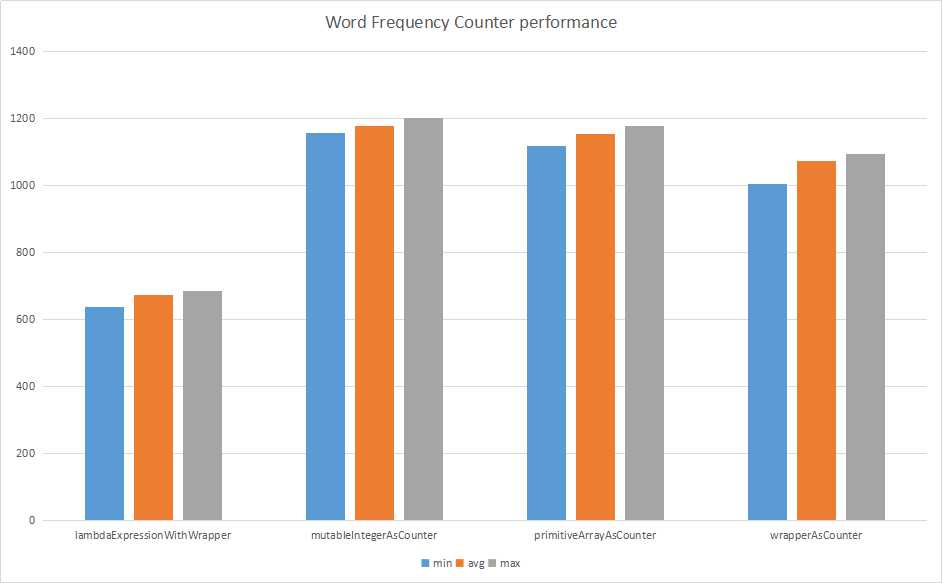
The above chart is created using JMH, and here’s the code that created the statistics above:
Map<String, Integer> counterMap = new HashMap<>();
Map<String, MutableInteger> counterMutableIntMap = new HashMap<>();
Map<String, int[]> counterWithIntArrayMap = new HashMap<>();
Map<String, Long> counterWithLongWrapperMap = new HashMap<>();

@Benchmark
public void wrapperAsCounter() {
    counterWithWrapperObject(counterMap);
}

@Benchmark
public void lambdaExpressionWithWrapper() {
    counterWithLambdaAndWrapper(counterWithLongWrapperMap );
}

@Benchmark
public void parallelStreamWithWrapper() {
    counterWithParallelStreamAndWrapper(counterWithLongWrapperStreamMap);
}

@Benchmark
public void mutableIntegerAsCounter() {
    counterWithMutableInteger(counterMutableIntMap);
}

@Benchmark
public void mapWithPrimitiveArray() {
   counterWithPrimitiveArray(counterWithIntArrayMap);
}
4. Conclusion
In this quick article, we illustrated various ways of creating word counters using Java.














